Tuesday, October 11, 2011

That's bazaar

Teaching at a college in China has been a hefty experience in innumerable ways. Paradoxically joyous and aggravating, simple and complex, encouraging and disheartening, I have been left with a mixed bag of emotional and mental puzzle pieces that defy my ability to organize them into a neat and tidy whole. Some experiences levy a substantial burden or leave me frustrated, others foster euphoric feelings of fulfillment or provide uplifting memories. As my second year here takes full stride I am gifted with the luxury of comparison and reflection--comparing myself now to myself from last year, reflecting on my growth, and (trying to) piece together all the things I've absorbed about China in the last year so that I may better understand my place, my impact, my direction in this new year. 

And that is the joy of returning for a second year: I can relive my life just as I lived it a year ago, but with the added bonus of essentially having a second chance. How will my approach to teaching, to students, to the school be different this time around? How will my ever-growing reservoir of knowledge on China shape the way I view and encounter the same situations as last year? Exploring these questions is a primary task, and I want to include you in a little bit of this. I have a much better handle on China, as a whole, than the first time around and I feel a deep desire to share with you what I have come to understand and know. Acknowledging that my own biases and still-incomplete comprehension of China serve as impedimenta towards your vicarious Chinese enlightenment, I will charge ahead anyway in my best attempt to show you the pieces of China you aren't likely to hear about. 

It seems appropriate, then, that I'd begin with a post about the place where I work, because the world of Hebei Vocational College for Foreign Language (my school) has very little to do with your expectations of what an institution of higher education should be, assuming you believe it should be fair, of professional quality, egalitarian, useful, and finally, for the purpose of educating and not profiteering off students with no better alternative. More on this later, of course, but I feel that I should now clarify: I know there are many skilled and dedicated teachers at this college. That being said, the school as a whole, and particularly the leaders in charge of the school's vision, mission, and general operation, garner little respect from students and foreign teachers alike (and possibly the Chinese teachers--I haven't asked). 

I will begin by explaining one of the most intriguing aspects of college/university orientation in China: military training. Being more of a misnomer than something you should worry about, the military training actually consists of very little in the way of combat preparation. Every college and university freshman in China is required to participate and, depending on the individual school, will spend the very first two to four weeks of his or her college life exclusively engaged in training.

Students passing by my apartment window in formation

Students are placed in units, each led by a soldier from the People's Liberation Army (China's national military). Dressed in the military uniforms supplied by the school (in some schools it's full fatigues, at my school just a camouflage shirt and track pants), students spend each day learning to march in formation, listening to stories and advice from soldiers, and digesting a sizable portion of communist propaganda. (Officially, propaganda isn't considered a bad thing in China--the "Propaganda and Ideology" body, alongside others like "Finance and Economy" and "Foreign Affairs", is one of the nine core bodies that constitute China's entire domestic and foreign agenda.) 

Demonstrating Chinese-style marching

Students are also given key tips for academic success as well as loads of practical advice, like what to do in case of an earthquake or how to use a fire extinguisher, among other things. 

Waiting... for more marching

The second and third-year students, long-ago complete with their training, seem to regard that time with a sort of confused nostalgia: happy that the long days of marching practice are over, slightly sentimental for the camaraderie that one develops when required to march ad nauseam alongside your cohorts, but not really sure about either.

What is sure are the benefits to the Communist Party. At a time in life when students traditionally are set free to discover and express newfound independence, challenge their world, and critique that which is worth critiquing, Chinese students are sprayed with propaganda and washed in conformity that can't really get any more conformed: wearing the same clothes, marching the same way, chanting the same things. It is this conformity (boosted here in the training but also constantly fostered by Chinese culture's tendency to favor communalism over individualism) that can deter most from engendering any challenges to the status quo--at least publicly. Borne out of the period immediately following a certain June event in 1989, there is little doubt in my mind that a significant goal of this military training is to groom and indoctrinate the demographic that was largely responsible for the events of that historical bedlam in 1989. 


Edit 11/14/11: After reading this piece in Foreign Policy on the very topic of Freshmen military training, I have decided it appropriate to update this post, mostly because my understanding and general opinion of the training has shifted. First, I must correct my mistake about the origins of the training: mandatory nation-wide training began in 1985, not four years later in the wake of the 1989 demonstrations. Second, I feel I must downplay the initial tone that this training is some kind of intense indoctrination and brainwashing. While there are certainly healthy doses of Party propaganda throughout the training, the insights from the FP article, alongside my own reflections, have given me a more reserved opinion on the matter of this supposed "Communist reeducation." I do not (nor did I ever) believe this training results in the production of generations of conditioned Party-loyal automatons who are unable to think and act for themselves, nor do I think the training is truly successful in blotting out any critical thinking and creativity (you can thank 18 years of Chinese Education for already handling that). And I don't think that was ever the purpose. As for the actual intent of the military training, we can look to China's Education Ministry. According to the Ministry, the official purpose is "to enhance students' sense of national defense and national security awareness." It also aims to improve "patriotism, collectivism, and revolutionary heroism" and "enhance organizational discipline" so the country can "develop socialist builders and successors of the future."* But you and I both know that's just lofty rhetoric. You can certainly identify dubious-sounding intentions, but from observations, conversations, and readings on the topic, I have come to believe the training yields little more than a heightened pride in the People's Liberation Army and a sense of independence, strength, and accomplishment. Maybe the students come out of it more sheep-like than before, but I just don't feel that is a distinction that will last, especially with this post-90s (i.e., more "Western") generation. So no need to lose any sleep.


*Taken from the FP article by Eric Fish


On a lighter note, I wanted to share one of my favorite parts from the opening weeks: the night bazaar. Upper-class students take to the street in haphazard fashion with their unwanted clothes, shoes, accessories, and school supplies from years past in hopes that the new students can take some of it off their hands. Now, however, many "booths" consist of enterprising students who buy items wholesale or at incredibly cheap prices and then resell them to turn a profit. (My former student, Boss, is quite adept at this style of retail. Not surprisingly, her ultimate goal is to be the manager of her own clothing shop.)

Sellers hawk their wares, spread out on a blanket for shoppers to browse. 

Some Freshmen inspecting the latest curb-side fashions

Complete with live music and entertainment, the make-shift bazaar is also a great place to stroll and people watch.
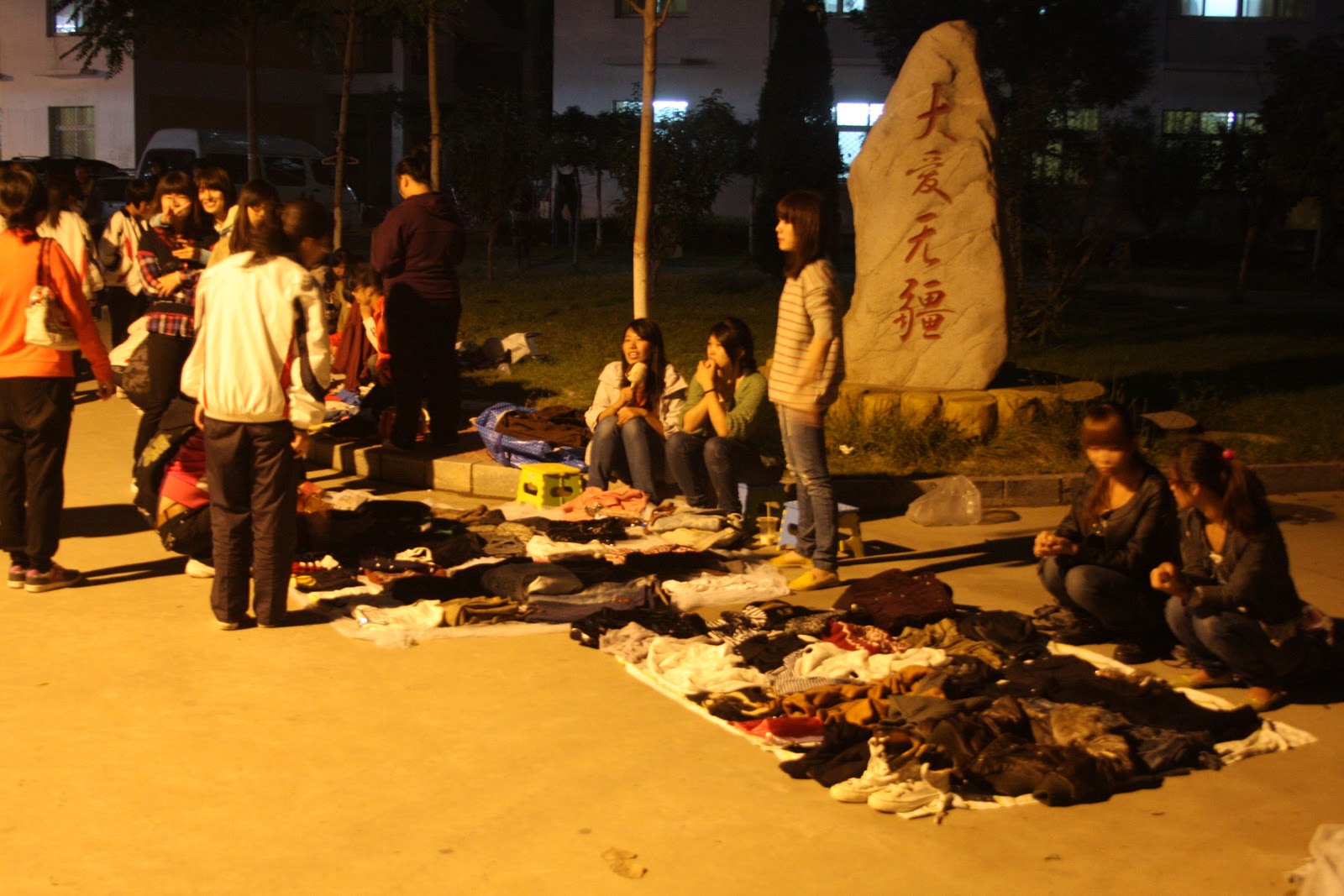


A simple stroll through any market can yield many things--in this particular case, I am peppered with muted hellos and ill-timed questions of where I'm from and how I'm doing. Too timid to engage me directly in conversation but not willing to let an opportunity to talk to a foreigner pass by, many students employ a sort of "cat call" method of catching my attention: tossing out little English greetings, words, and phrases, often from afar or several seconds after our paths have already crossed, in hopes that they can catch me. Should I take the bait, giggling will ensue, and then I just might walk over and start speaking with them. Endlessly amusing.


Just like China.


Wednesday, September 28, 2011

A year in China: looking forward to looking back

Putting thoughts into words is a daunting task, especially for me. Especially when those thoughts are reflections on a year spent living in China. Imagine summarizing your previous year in a blog post. Now multiply that by seven because you've been living in China (and in China, everything is apparently seven times crazier/stranger/wackier/more memorable). What follows, then, is my failed attempt to do such a thing, because it is therapeutic for me (I need the closure) and because it is interesting to you... I hope. Be warned: it might get messy. Regardless, I will plow ahead without regard for sound logic or credible thought--basically like anything Glenn Beck says.


Living in a completely different country is bound to teach you some lessons. Some might be of a more practical nature, applicable anywhere. Study the language and embrace the culture. Make friends with locals. Avoid death. Other lessons will, of course, be more specific to the country. Never travel by train during the Spring, National, or May holidays and always make reservations, even at that quaint little hostel you think no one else knows about. Take all vegetable-flavored ice cream and candy seriously. Avoid death by illegal car service to Beijing. Finally, you have the grand lessons. You know--the life-lessons that will make you a better person as you head off on your way, filled with a nice dose of feel-goodery and enlightened appreciation for your global neighbor. So what do I say? That I learned every culture is unique and beautiful and rich? That the intricate fabric of our humanity weaves us closer together than the rifts that separate us?


Junk. 


Often true, but still junk. I didn't live and think and grow for a year in China to spew out trite sentiment. You can get that on Lifetime.  


There are plenty of easy answers to give you. It's certainly easy enough to say something fuzzy and clichéd, like living a year in China taught me to be more patient and more flexible. Of course it did. Things in China are constantly changing and happening, often without warning or perceptible logic. If I don't learn these two basic things, I'm done. Maybe I could say I learned just how fortunate I am: to be an American and enjoy the freedoms and opportunities I've had, to have the loving and supportive family that I do, to have so much more money and possessions than the overwhelming majority of the world. So it really took living in a different country to figure that out? Then this has to be something different, something better than a dollar store answer.


And therein lies the problem. How does one go about conveying such a thing? The real lessons--the ones you piece together only after significant time and thought--are much more elusive, to grasp and to share with others. Some things were just not meant to be easy. Maybe some reverse engineering is in order--starting with the ultimate take-away from my first year in China and then working backwards to parse apart the various reasons that have come together to give me that particular take-away. So here it is, my ultimate lesson from China, my big take-away, the sound-bite I would tell you if I had to say just one thing: I belong here; there is simply no place else that I can be, at least for now.


I like to think that living in China has helped me get my priorities straight. In the U.S., I was busy. Always busy. So busy that I neglected the things that matter most: reading the Good Book daily, speaking with the Father many times throughout each day, enjoying the pleasure of a good meal or a good conversation with good company, devoting my time and love to others, enjoying the moment. And it felt pretty empty, all this busyness. I wasn't busy following my passions or meeting the needs of others. I was busy waiting for 5:00 to come, busy waiting for the weekend, busy thinking about the next movie I'd watch. Stupid busy. Selfish busy. 


I have a simple job that requires no more than 22-23 hours of my time in an average week. I am afforded a wealth of time, and I have no trouble spending it well. I am busy, but this time I am good busy. I'm busy meeting with students: to eat, to play basketball and ping pong, to have good conversations, to cook Chinese food, to share my life. I'm busy learning to speak Mandarin so that I can really get to know this country (i.e., know the hearts and minds of the Chinese people--only truly accessed through their language). I'm busy reading (books and blogs and articles) about China, talking about China, and thinking about China so that I can learn how to love this place, these people even more--and then share that with others. Spending time this way is wonderful. Won't you try it? 


So now there is this ability to organize my life in some important ways. No longer confined by the struggles of my American life, I can embrace my Chinese one where I joyfully spend time following the passions of my heart (i.e., China and the Chinese people). Being here gives me this clarity about what matters, but perhaps more importantly, about what doesn't matter: my "precious" rights, my entitlements, my self. Me. What remains, then, is relatively simple: 1) Follow the Father first; 2) Shut up and stop complaining; 3) it's not about me; 4) shut up already and stop complaining. 


I am especially hard on myself in regards to points two and four for two reasons, the first being that coming from the country I do, the background I do, I have no place to gripe or complain. None. The US is not perfect, my family is not perfect, but they are immeasurably better than the hand that the vast majority of Chinese have been dealt. Second, I've spend a lot of my life stewing over things that just don't matter. Standing on the bus next to one of China's 200 million migrant workers (who is away from his wife and two children 50 weeks a year to make 800RMB per month [about $123]), who am I to complain when I can't afford to backpack in Europe like I'd dream to? When I see pictures of children like these, who am I to complain that there aren't many restaurants I like in the town where my parents live? When my students ride 18 hours through the night in a packed standing-room-only train every time they travel between their home and school, who am I to complain that it took six hours instead of the usual three to get to Beijing in a private car? 


The fact is I can't. I have led a ridiculously privileged life, and living here is a daily lesson in humility. I am humbled by what ordinary Chinese have endured in their painful history and what they continue to endure today. I don't feel guilty for what I have been given, but be darn sure that I won't take it for granted anymore. 


****       ****       ****

For many, coming to live in China is a chance to run away, to have a big, fat adventure, to add more to their repertoire of cocktail party anecdotes. A person with those motives might be prone to say many things about their place in China, but I'd venture a guess to say that they wouldn't claim they belong here. I think often of Buechner's words on the subject of calling and vocation. He said, "The place the Father calls you to is the place where your deep gladness and the world's deep hunger meet." Could there be a more perfect appraisal of my time, my purpose in China? 

Wednesday, June 15, 2011

It's about that time...

I leave for the Beijing airport in five hours. My flight lands in the US in another 26. In 30 hours I will be eating Raisin Bran Crunch at my parents' house. 

These are things that once seemed so distant. They seemed beyond the reach of my calendar. Now, they seem to come too soon. 

But they are here, ready to take me away from this wonderful place to another place that, at this moment, seems wonderful because there will be Cinnamon Life cereal and Sam Adams Cherry Wheat. I am glad to be going back to visit the US--don't get me wrong--but the transition is bittersweet. I don't really want to leave...

...but all good things must end, right? Maybe? Sometimes? 

But not yet. It's not over for me, and really, this might just be the beginning. I'm going back to the US for two months, but I'll be coming right back here. And next time I might just stay a little longer.

This summer break is really not so different than the two-month winter break I took after the fall semester, with the notable exception that I won't be incommunicado the whole time traveling around SE Asia. I don't have to feel sad about leaving because when I come back everything will be waiting just as I left it, friends and apartment and all. I suppose the time will fly and I'll be back here in China sooner than I realize. 

This summer will be many things, one of which will hopefully be a convenient chunk of time to reflect on the previous year. So stick with me--I have lots to post as I process the last 10 months and have more time to write about the myriad topics I've been pining to tell you about. Until later. 

Friday, June 3, 2011

How do you think American's culture?

An interesting question, perhaps one to be explored later, but providing an answer--or discerning the actual meaning--is not the reason that I mention it. I chose it to demonstrate a fairly typical example of Chinglish--what I encounter on a daily basis from signs, clothing, and my students. Generally, Chinglish refers to English that is influenced by the Chinese language. 


We are all aware of the bizarre, comical, and sometimes gut-bustingly hilarious examples of poor English translations that originate out of China, but why is it so prevalent here? What is it about the Chinese-to-English translation that lends itself to such bemusing results? The easy answer is to stay it stems from a limited grasp of English--which is true--but that doesn't explain why China seems to have such a high rate of hilarious and epically botched attempts at English relative to other countries. The answer lies in the nature of the two languages. Specifically, the grammatical differences, which provide a wealth of areas where translating can go wrong, usually with hilarious results. 


Chinese is a difficult language. The Cubs may never win it. The Back to the Future trilogy is one of the greatest trilogies ever conceived. All quite obvious things, yet I feel there is a bit more about Mandarin Chinese that you should know before you write it off as one of life's greatest mysteries: it's not so crazy, and learning English from a Chinese context can be just as daunting (I think). But yes, you're right: Chinese language is a juggernaut not easily tamed.  


But there is an angel, and its name is grammar. Where Lady Mandarin perplexes and confounds my efforts to learn her words, her dear grammar is a sweet and unbelievably simple melody--it makes English grammar look like differential calculus on crack. Here's just a taste: 


NO:
-plurals
-articles
-conjugation
-genders
-tense


Great news for me. Beautiful. But here's where the difficulty of learning English in a Chinese context levels the playing field a bit. Understandably, moving from the grammatically simple Mandarin to the absurdly complex English is no walk in the park. 


And thus, Chinglish is born. Through the rest of this post are some favorite examples I've pulled from just this last week of class (I had some American visitors in class and gave my students a chance to write down any questions they had to ask my guests). 
  
-How do you think American's culture?
-How do you think about China?
-How do you think of Chinese girl?
-How do you think freedom?


A common tendency of my students is to ask 'how' as opposed to 'what' when asking for my opinion/feeling about something. This is because in Chinese, the equivalent question  typically begins with the word 怎么 (zenme), which translates into English as 'how'--a good example of when a sentence is first created in Chinese and then translated word for word into English (usually a recipe for disaster). You will also notice, as demonstrated by the lack of 'about' or 'of' in the first and last sentences, that prepositions constantly present the Chinese with trouble, especially since Chinese is primarily a postposition language. Some more examples:


-Do you smoking? 
-Are you have girlfriend?
-Are you like to eat Chinese food? 
-Are you like volleyball?
-How old are the old man?
-What are their name?
-Does all American likes fast food?


Conjugation is perhaps the biggest culprit in Chinglish conception--here we see the common difficulties with do/does/are/is/was/be/etc. Combined with tenses, you've got a perfect storm for Chinglish. Here are a few more conjugation beauties you might hear on any given day:


-"To be honestly, I think..."
-"Water is good for your healthy."
-"What are you think about?"
-"We were talk to you last night."
-"How long have you been live in China?"


...and I could go on for pages, but you get the idea. For me, it's a never-ending joy ride through the beauties of language. I love it. 


Another difficulty that I find quite amusing is the trouble with articles, particularly 'a' and 'the': 


-Do you have the boyfriend/girlfriend?
-Do you believe in the God?
-In China how do you think about the society? 
-Do you have bike?
-Can you drive car?


Again, this could go on. I've actually turned this into a little game for me, for my own amusement. I add/remove/change articles when appropriate. Wait, I'll ask the friend. Do you have an internet? When will you go back to the America? 


A lack of gender in Chinese language also makes it difficult when speaking English. My students routinely mix up 'he' and 'she', although for this problem they are always quite quick to fix it. Still, it's amusing.  


Word order is often quite different between Chinese and English, so in the common event that a Chinese sentence was simply translated word for word into English, you get some pretty good gems. That, combined with improper translation of words, can lead to some real beauties, usually seen on signs or clothing:


-"Please accept inspection consciously"
-"Please slip carefully"
-"No Nearing"


And now for the rest of the student responses I kept from last week, he he. Some demonstrate the difficulties I mentioned before, while others are straight-up epic. You'll see what I mean.


-I want to know if America use chopsticks?
-Which food do you favorite in China?
-What means of American Halloween?
-Why did you choose to this?
-In America are there all the students work hard. Why?
-Which several parts that American culture by?
-What kind of forms that American wedding?
-Why the Americans are like football?
-Americans to Chinese impression.
-What's you like most of China.
-The differences with other national, and the Americans very special habits. 
-Who is your worship of idols?
-Why the USA family have too many Children?


The last question is my favorite. You can't make this stuff up.


And to be clear, this post is not meant to make a mockery of my dear Chinese students and friends. I have no doubts that, should I be in their shoes, my attempts at English would be just as mangled. I simply want to share with you the joys of being a native English speaker in China, and that learning a new language, while frustrating at times, is quite hilarious and wonderful during others. 


And so that's it for my mini lesson on Chinglish--and I didn't each touch the difficulties that the Chinese have with speaking/pronouncing English--that's a whole other world altogether. Just consider yourself lucky (assuming you're a native speaker) that you don't have to learn English pronunciation, because it's seriously messed up. (Really, have you ever tried explaining why 'flower' and 'flour' are pronounced the same? Or why 'boot' sounds like 'hoot', but 'foot' sounds like 'put'?) Chinese pronunciation is much simpler and consistent in this way. But English? There are about 10,000 different sounds to pronounce. 


I'm counting my blessings on that one.