Teaching at a college in China has been a hefty experience in innumerable ways. Paradoxically joyous and aggravating, simple and complex, encouraging and disheartening, I have been left with a mixed bag of emotional and mental puzzle pieces that defy my ability to organize them into a neat and tidy whole. Some experiences levy a substantial burden or leave me frustrated, others foster euphoric feelings of fulfillment or provide uplifting memories. As my second year here takes full stride I am gifted with the luxury of comparison and reflection--comparing myself now to myself from last year, reflecting on my growth, and (trying to) piece together all the things I've absorbed about China in the last year so that I may better understand my place, my impact, my direction in this new year.
And that is the joy of returning for a second year: I can relive my life just as I lived it a year ago, but with the added bonus of essentially having a second chance. How will my approach to teaching, to students, to the school be different this time around? How will my ever-growing reservoir of knowledge on China shape the way I view and encounter the same situations as last year? Exploring these questions is a primary task, and I want to include you in a little bit of this. I have a much better handle on China, as a whole, than the first time around and I feel a deep desire to share with you what I have come to understand and know. Acknowledging that my own biases and still-incomplete comprehension of China serve as impedimenta towards your vicarious Chinese enlightenment, I will charge ahead anyway in my best attempt to show you the pieces of China you aren't likely to hear about.
It seems appropriate, then, that I'd begin with a post about the place where I work, because the world of Hebei Vocational College for Foreign Language (my school) has very little to do with your expectations of what an institution of higher education should be, assuming you believe it should be fair, of professional quality, egalitarian, useful, and finally, for the purpose of educating and not profiteering off students with no better alternative. More on this later, of course, but I feel that I should now clarify: I know there are many skilled and dedicated teachers at this college. That being said, the school as a whole, and particularly the leaders in charge of the school's vision, mission, and general operation, garner little respect from students and foreign teachers alike (and possibly the Chinese teachers--I haven't asked).
I will begin by explaining one of the most intriguing aspects of college/university orientation in China: military training. Being more of a misnomer than something you should worry about, the military training actually consists of very little in the way of combat preparation. Every college and university freshman in China is required to participate and, depending on the individual school, will spend the very first two to four weeks of his or her college life exclusively engaged in training.
Students passing by my apartment window in formation
Students are placed in units, each led by a soldier from the People's Liberation Army (China's national military). Dressed in the military uniforms supplied by the school (in some schools it's full fatigues, at my school just a camouflage shirt and track pants), students spend each day learning to march in formation, listening to stories and advice from soldiers, and digesting a sizable portion of communist propaganda. (Officially, propaganda isn't considered a bad thing in China--the "Propaganda and Ideology" body, alongside others like "Finance and Economy" and "Foreign Affairs", is one of the nine core bodies that constitute China's entire domestic and foreign agenda.)
Demonstrating Chinese-style marching
Students are also given key tips for academic success as well as loads of practical advice, like what to do in case of an earthquake or how to use a fire extinguisher, among other things.
Waiting... for more marching
The second and third-year students, long-ago complete with their training, seem to regard that time with a sort of confused nostalgia: happy that the long days of marching practice are over, slightly sentimental for the camaraderie that one develops when required to march ad nauseam alongside your cohorts, but not really sure about either.
What is sure are the benefits to the Communist Party. At a time in life when students traditionally are set free to discover and express newfound independence, challenge their world, and critique that which is worth critiquing, Chinese students are sprayed with propaganda and washed in conformity that can't really get any more conformed: wearing the same clothes, marching the same way, chanting the same things. It is this conformity (boosted here in the training but also constantly fostered by Chinese culture's tendency to favor communalism over individualism) that can deter most from engendering any challenges to the status quo--at least publicly. Borne out of the period immediately following a certain June event in 1989, there is little doubt in my mind that a significant goal of this military training is to groom and indoctrinate the demographic that was largely responsible for the events of that historical bedlam in 1989.
Edit 11/14/11: After reading this piece in Foreign Policy on the very topic of Freshmen military training, I have decided it appropriate to update this post, mostly because my understanding and general opinion of the training has shifted. First, I must correct my mistake about the origins of the training: mandatory nation-wide training began in 1985, not four years later in the wake of the 1989 demonstrations. Second, I feel I must downplay the initial tone that this training is some kind of intense indoctrination and brainwashing. While there are certainly healthy doses of Party propaganda throughout the training, the insights from the FP article, alongside my own reflections, have given me a more reserved opinion on the matter of this supposed "Communist reeducation." I do not (nor did I ever) believe this training results in the production of generations of conditioned Party-loyal automatons who are unable to think and act for themselves, nor do I think the training is truly successful in blotting out any critical thinking and creativity (you can thank 18 years of Chinese Education for already handling that). And I don't think that was ever the purpose. As for the actual intent of the military training, we can look to China's Education Ministry. According to the Ministry, the official purpose is "to enhance students' sense of national defense and national security awareness." It also aims to improve "patriotism, collectivism, and revolutionary heroism" and "enhance organizational discipline" so the country can "develop socialist builders and successors of the future."* But you and I both know that's just lofty rhetoric. You can certainly identify dubious-sounding intentions, but from observations, conversations, and readings on the topic, I have come to believe the training yields little more than a heightened pride in the People's Liberation Army and a sense of independence, strength, and accomplishment. Maybe the students come out of it more sheep-like than before, but I just don't feel that is a distinction that will last, especially with this post-90s (i.e., more "Western") generation. So no need to lose any sleep.
*Taken from the FP article by Eric Fish


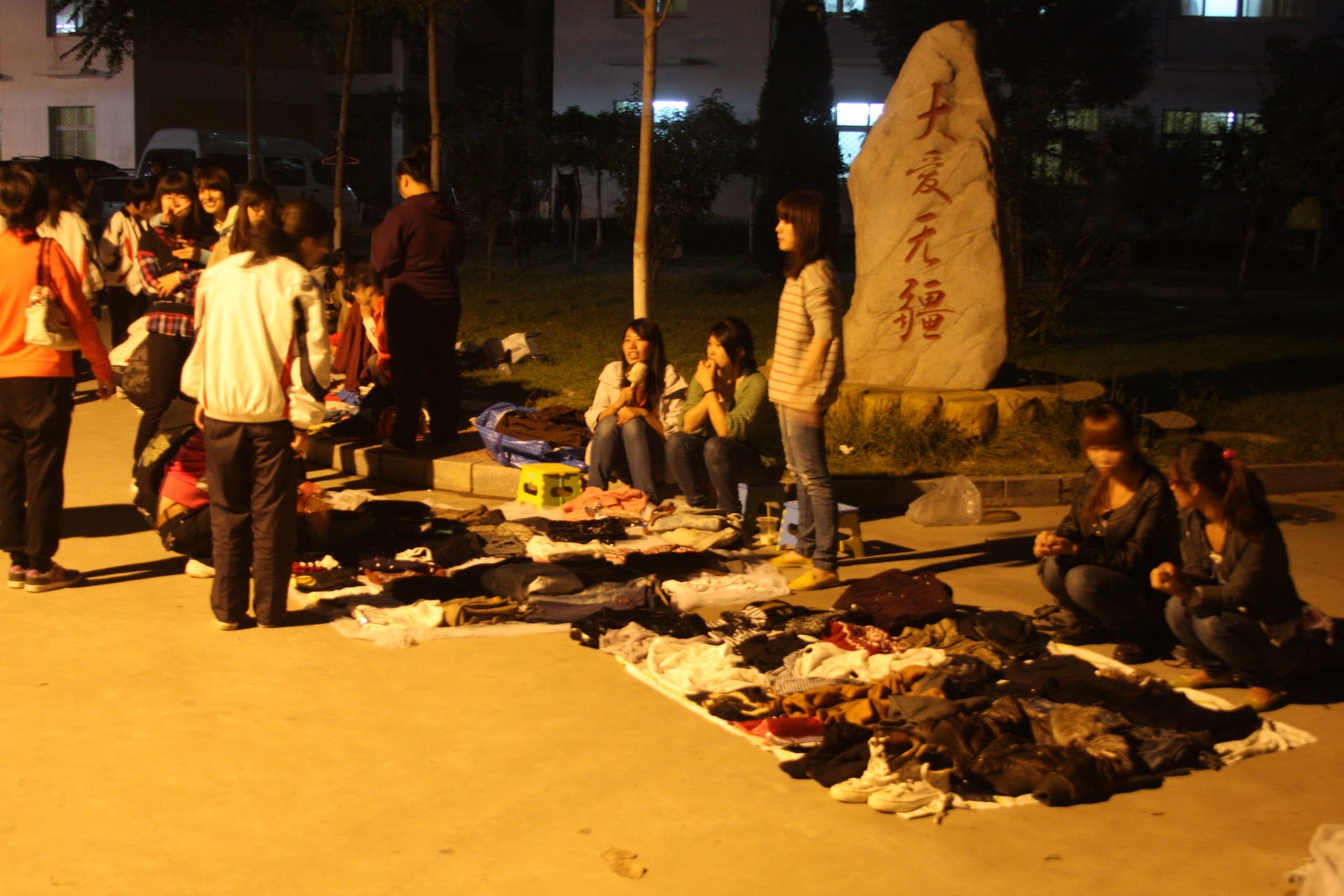
On a lighter note, I wanted to share one of my favorite parts from the opening weeks: the night bazaar. Upper-class students take to the street in haphazard fashion with their unwanted clothes, shoes, accessories, and school supplies from years past in hopes that the new students can take some of it off their hands. Now, however, many "booths" consist of enterprising students who buy items wholesale or at incredibly cheap prices and then resell them to turn a profit. (My former student, Boss, is quite adept at this style of retail. Not surprisingly, her ultimate goal is to be the manager of her own clothing shop.)
Sellers hawk their wares, spread out on a blanket for shoppers to browse.
Some Freshmen inspecting the latest curb-side fashions
Complete with live music and entertainment, the make-shift bazaar is also a great place to stroll and people watch.
A simple stroll through any market can yield many things--in this particular case, I am peppered with muted hellos and ill-timed questions of where I'm from and how I'm doing. Too timid to engage me directly in conversation but not willing to let an opportunity to talk to a foreigner pass by, many students employ a sort of "cat call" method of catching my attention: tossing out little English greetings, words, and phrases, often from afar or several seconds after our paths have already crossed, in hopes that they can catch me. Should I take the bait, giggling will ensue, and then I just might walk over and start speaking with them. Endlessly amusing.
Just like China.